Ever since I was little I have loved animals, often more than people. I was always worried if the smallest thing seemed wrong and have been, ironically, always drawn to the runt or injured animal. Ever pet I can ever remember getting or being impacted by has been a stray, rescue, or been from a litter of family friend's pet. (The only exception is my family dog who, to my somewhat objection, was gotten from an Amish family- though since she turned out to be a runt, I guess it makes sense that she ended up in my life.) Recently my sister and I took in a stray cat who wandered into our apartment building- it was pouring outside and we didn't have the heart to send her back out.
Although I have never volunteered at an animal shelter, I have always been interested in it and this course has become the push that I needed to get past my selfish reasons for not going and just go. I am excited and nervous about the things I will encounter while volunteering, but I am appreciative to have gotten some foundation through texts and speakers to accompany me through the process.
I became very pleased when told the survival rate of the PSPCA, as well as, motivated by the devotion of volunteers and community members. I was also very intrigued by the retirement camps that Rachel talked about, as well as, the major influences that Philadelphia had on animal rights and welfare progress. I hadn't previously known how influential Philadelphia was, significantly in starting the move to create shelters to help alleviate moral dilemmas of killing almost all the animals that were supposed to be saved.
My greatest worry is that I will become disheartened, frustrated, and saddened by the backgrounds of the animals at the PSPCA. After gaining insight about how important and influential interactions with animals can be (from "Why Look At Animals), I have developed a new goal to connect personally with the animals and not let any agitations or disapprovals that I may have of their owners negatively affect the animals by affecting my emotion state and non-verbal signals.
I am glad to have the opportunity to apply principles and findings from class and academic work to hands-on, personal work and vice versa. I am also interested in what connections I might make and what I may find out about myself and others along the way.
Thursday, February 7, 2013

Fresh Start
I think that the most valuable part of this class was to
introduce me to life at the shelter. I have had a very “middle class” experience
with animals in that they have always been someone’s pet and well cared for. During
the fall semester, my roommate and I began fostering cats and being at the
shelter felt like an extension of this new home life. Even though I barely knew
these animals, I felt like I was immediately protective of the animals of the
prospective owners coming through. I also felt a responsibility towards these
animals that I think stays with anyone who has the chance to be in this
environment. Leaving the shelter has mixed feelings of sadness but I also felt
really happy for them in a strange way. Even though they are stuck in a crate,
the volunteers that come through have a genuine interest in the socializing them
and the overall welfare of the animals. I really loved that the trainer at the
PSPCA said that every time she leaves the shelter she feels like she has
accomplished something. I think this is 100 percent true and just from being
there for a few hours I felt like the animals, as well as myself, had been
impacted in a positive way.
On a different note, I really enjoyed the presentations that
we have experienced in class so far. Whenever my family comes to visit, I am an
absolute nerd and spit out all these random facts that I’ve learned about
Philadelphia over the years. I had never known about the animal movements in
Philadelphia and how large of a role it played. Over the course of the
semester, it will be interesting to immerse myself in the culture of
Philadelphia in this totally new way.
Happiness Through Animals 2900

Building a Comprehensive Understanding of Animal Ethics
The information from Rachel McCrystal's presentation this past Tuesday overlapped with a lot of the information from our first reading assignment in The Animal Ethics Reader. Both discussed the history of the animal welfare and rights movements, making note of the early focus on horses and anti-vivisection, rather than on companion animals such as cats and dogs. In comparing these two sources, I feel that they complimented each other quite nicely. I believe The Animal Ethics Reader did a wonderful job detailing the history of vegetarianism, while Rachel's presentation did an amazing job detailing the history of shelter organizations, and the role that women played in the movement's early stages. Because we are a class of all females (with the exception of Dan, of course!) I think it is empowering to learn about the roles women have played throughout history, despite obstacles they may have faced.
The presentation also introduced us into volunteering at the PSPCA this semester. I was there this past weekend, getting trained to work with cats and dogs, and I think it will feel even more meaningful now that I know about the origins of the shelter and the processes it took to get there. I would love to see this movement continue to advance, particularly in the shelters (since we are discussing companion animals, and not factory farming).
Lastly, I appreciate the multiple approaches this class is taking in terms of discourse -- we are incorporating ideas from history, philosophy, women's studies, literature-studies, and community-based learning, and I think it will provide those of us in the class with a more comprehensive understanding of the relationships, thoughts, and beliefs people have regarding animals than any average person would even be aware of. This knowledge will propel us to introduce the subject to others in a form that is not structured on thoughtlessness and ignorance, but on informative, and thought-out reason.
The presentation also introduced us into volunteering at the PSPCA this semester. I was there this past weekend, getting trained to work with cats and dogs, and I think it will feel even more meaningful now that I know about the origins of the shelter and the processes it took to get there. I would love to see this movement continue to advance, particularly in the shelters (since we are discussing companion animals, and not factory farming).
Lastly, I appreciate the multiple approaches this class is taking in terms of discourse -- we are incorporating ideas from history, philosophy, women's studies, literature-studies, and community-based learning, and I think it will provide those of us in the class with a more comprehensive understanding of the relationships, thoughts, and beliefs people have regarding animals than any average person would even be aware of. This knowledge will propel us to introduce the subject to others in a form that is not structured on thoughtlessness and ignorance, but on informative, and thought-out reason.
Wednesday, February 6, 2013
Connecting to "the animal"
Even though I have been volunteering at animal shelters and
rescues since I was a little girl, this past trip to the PSPCA was different. While the scenery was more or less the same, after having
read and discussed the origins and various definitions of “the animal” in
class, my perceptions of the animals at the shelter were significantly more
complex and powerful. For example, how can a cat or dog rubbing up against the
bars of his or her cage, begging for attention and love be considered a machine?
Searching for love, connection and care are not mechanical characteristics as
far as I can see. This past at the PSPCA
allowed for me to clearly see that animals have the same desires that we do
deep down inside: security, acceptance, companionship and so much more. The
only difference that I could see while spending time with the furry felines at
the PSPCA is that they don’t make as much of a fuss over appearances and
intellectual and societal status as much as we humans do.
Leaving the PSPCA, I couldn’t help but feel overwhelmed and saddened for the animals that are living inside those relatively tiny cells, with people streaming in and out the doors pointing and talking and grabbing. Perhaps it’s not that type of situation that saddens me, but rather the fact that the animals must have no idea why they are confined and why so many people are staring at them but not necessarily giving them the love and security they so desire.
Leaving the PSPCA, I couldn’t help but feel overwhelmed and saddened for the animals that are living inside those relatively tiny cells, with people streaming in and out the doors pointing and talking and grabbing. Perhaps it’s not that type of situation that saddens me, but rather the fact that the animals must have no idea why they are confined and why so many people are staring at them but not necessarily giving them the love and security they so desire.
After hearing Rachel McCrystal and Mazzy’s presentation, I
no longer felt as sad and overwhelmed as I originally had. I learned so much
after that class… I had no idea how monumental Philadelphia was and has been in
the animal welfare (and rights) movement and how vital of a role the PSPCA has
played in the helping and healing of so many animals. I can now see that the
animals at the PSPCA are not “sad” cases. The sole fact that they are being
sheltered from the storm of animal cruelty and neglect until a furrever home
can be found for them is so uplifting.
One aspect of Rachel’s presentation that resonated with me
the most was the section on Caroline Earle White. Before she founded the
Women’s PSPCA (now Woman’s Humane Society), so much was being done to get stray
dogs off the streets and to humanely care for agricultural and particularly
industrial animals. But White saw that while these efforts were an extremely
consequential part of the movement, they only acted as a band-aid to the
problem, hence her opening up the first shelter in America and the first
adoption program. Adoptions of rescued animals are becoming more and more
popular and progressive, as I could clearly see by the swarms of people
bustling through the halls of the PSPCA during adoption hours.
Two things remain clear to me after volunteering at the
PSPCA and listening to the animal welfare presentation: in order for success to
be made in the movement, people must 1) learn to care for other animals besides
themselves and their own species be it through introspection or personal
connections, and 2) those who are already active and aware must spread their notions
by means of education and first-hand experiences.
From Heather Dyer
Attending the Pennsylvania SPCA has helped me understand the idea that animals are companions, not simply living machines. I love dogs, and when I was walking one dog in particular at the Pennsylvania SPCA, Bibi, a black pug-type mix, I felt as if I was not holding control over him, but rather we were simply coexisting and I was helping him to live a more enjoyable life during his time at the shelter. Bibi and I sat on a bench because the field behind the runs was muddy and we watched another dog and his companion play catch with a ball.
A connection I made between attending the Pennsylvania SPCA and an article was the equality shared between humans and animals, even though humans are moral agents with the ability to understand and exercise morality and animals are moral patients who are supposed to be incapable of committing actions against any morals. Although dogs and humans are equal in value, domesticated dogs rely on us to keep them healthy and happy. Because we are capable of taking care of not only ourselves but others, we have the duty to exercise our abilities for the betterment of others.
Attending the Pennsylvania SPCA is a good time to ask ourselves the question posed in Lynda Birke’s “Naming names - or, what’s in it for the animals” that considers what animals might think about what we do. When a dog sees you approaching their cage, they are beyond excited with the thought that they might get to go outside again. This is a perfect example of the varied roles we discussed in class that humans can play concerning animals. Humans can either have dominion over animals, as the Genesis chapter we read from the Bible stated, or we can exercise stewardship with the animals in an environment where we help them when they need it yet still coexist in harmony.
A connection I made between attending the Pennsylvania SPCA and an article was the equality shared between humans and animals, even though humans are moral agents with the ability to understand and exercise morality and animals are moral patients who are supposed to be incapable of committing actions against any morals. Although dogs and humans are equal in value, domesticated dogs rely on us to keep them healthy and happy. Because we are capable of taking care of not only ourselves but others, we have the duty to exercise our abilities for the betterment of others.
Attending the Pennsylvania SPCA is a good time to ask ourselves the question posed in Lynda Birke’s “Naming names - or, what’s in it for the animals” that considers what animals might think about what we do. When a dog sees you approaching their cage, they are beyond excited with the thought that they might get to go outside again. This is a perfect example of the varied roles we discussed in class that humans can play concerning animals. Humans can either have dominion over animals, as the Genesis chapter we read from the Bible stated, or we can exercise stewardship with the animals in an environment where we help them when they need it yet still coexist in harmony.
First day volunteering
Blog Post 1
Volunteering at the PSPCA was my first time volunteering at any animal shelter. What really struck me at first was the sheer amount of people and animals crammed into tiny waiting rooms and cages. Its a wonder that the staff there are doing so well. What also surprised me was how different the cats were to cats I had previously handled. I myself have had 2 cats and 2 dogs and (even though I'm much more of a dog person) I thought that I could handle cats pretty well. But I found myself feeling slightly intimidated by their fearlessness and unpredictability So many different personalities, interests, likes and dislikes really had me wondering how someone has intuitive as Renee Descartes could assume that animal lived by sheer instinct and not thought. A story that has confirmed in me the intelligence and capacity to think within animals was the story of Lucy the pig who saved her owner by attracting attention to herself by lying in the middle of a road until a motorist stopped. Lucy then took the motorist to her home to rescue her dying owner who was in the middle of a heart attack. If that's not thought then I don't know what is. Another thing I noticed was that, perhaps I'm over reaching here, but the manner in which people came in to adopt a cat or a dog reminded me a lot of how people go clothes shopping. Were they looking for a real life time companion or were they shopping for temporary excitement and satisfaction - the thrill of having a new pet? And who's to regulate that? Who can say that you can adopt but you can't. It seems that lack of education and knowledge about what adopting a new pet really means will lead to a lot of those animals being returned within days. Perhaps I'm being overly cynical but that was the impression I got.


Wednesday, May 25, 2011
COMMUNITY-BASED LEARNING PROJECT: CATS
(The final community-based learning project took place in the Student Center and focused on raising awareness about feral cats in our community.)


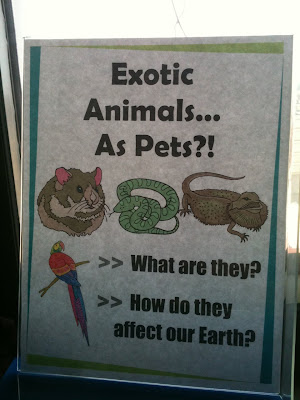
COMMUNITY-BASED LEARNING PROJECT: EXOTIC ANIMALS AND FARMED ANIMALS
(Students tabled at Temple's "Green Block Party" to raise awareness about human-animal relations issues in our community, including the exotic pets trade and the impact of animal agriculture on our environment.)


COMMUNITY-BASED LEARNING PROJECT: DOGS
(In conjunction with Temple's Promoters of Animal Welfare, the Pennsylvania SPCA, and PAWS, students focused on pit bull awareness and an "adopt don't shop" message.)


Subscribe to:
Posts (Atom)