 This is me being a cat couch, apparently. One of the many reasons why volunteering at the PSPCA is the best thing in the world.
Thursday, March 31, 2011
Too Precious Not to Post
This is me being a cat couch, apparently. One of the many reasons why volunteering at the PSPCA is the best thing in the world.

Sunday, March 27, 2011
Patrick's Law
I thought you guess might be interested to see this. There is a campaign to change the current laws in place that protect animals for abuse. These people are looking to increase the severity of violating these crimes. This was one of the reasons i was frustrated with animal law, but they are trying to change it!
http://www.patrickslaw.com/index.html
http://www.patrickslaw.com/index.html
Saturday, March 26, 2011
MAJOR ECOLOGICAL DISRUPTION: OUTDOOR CATS & THE ENVIRONMENT

We've talked in class about the impact of domesticate/companion animals on our environment. One example that affects our local communities is the outdoor cat. Over the years, a number of studies have linked both feral and free-ranging domesticate cats to ecological disruption, including bird predation that in turn impacts the rest of the ecosystem. Here's a recent article that appeared in the "Science" section of The New York Times:
Tweety Was Right: Cats Are a Bird’s No. 1 Enemy
By ELISABETH ROSENTHAL
While public attention has focused on wind turbines as a menace to birds, a new study shows that a far greater threat may be posed by a more familiar antagonist: the pet house cat.
A new study in The Journal of Ornithology on the mortality of baby gray catbirds in the Washington suburbs found that cats were the No. 1 killer in the area, by a large margin.
Nearly 80 percent of the birds were killed by predators, and cats were responsible for 47 percent of those deaths, according to the researchers, from the Smithsonian Institution and Towson University in Maryland. Death rates were particularly high in neighborhoods with large cat populations.
Predation was so serious in some areas that the catbirds could not replace their numbers for the next generation, according to the researchers, who affixed tiny radio transmitters to the birds to follow them. It is the first scientific study to calculate what fraction of bird deaths during the vulnerable fledgling stage can be attributed to cats.
“Cats are way up there in terms of threats to birds — they are a formidable force in driving out native species,” said Peter Marra of the Smithsonian Conservation Biology Institute, one of the authors of the study.
The American Bird Conservancy estimates that up to 500 million birds are killed each year by cats — about half by pets and half by feral felines. “I hope we can now stop minimizing and trivializing the impacts that outdoor cats have on the environment and start addressing the serious problem of cat predation,” said Darin Schroeder, the group’s vice president for conservation advocacy.
By contrast, 440,000 birds are killed by wind turbines each year, according to the United States Fish and Wildlife Service, although that number is expected to exceed one million by 2030 as the number of wind farms grows to meet increased demand.
The American Bird Conservancy generally supports the development of wind energy, but it argues that wind farms should be “bird smart” — for example, positioned so that they do not interfere with major migration paths or disturb breeding grounds, with their power lines buried to prevent collisions.
“I’m excited about wind; we just have to be careful where and how we put the turbines,” said Dr. Marra, who studies threats to birds, including from climate change and habitat loss. He said the leading cause of bird deaths over all, as opposed to the catbird fledglings in the study, remained collisions with buildings, windows and towers, followed by predators.
Yet wind turbines often provoke greater outrage than cats do, said Gavin Shire, vice president of the Bird Conservancy. “The idea of a man-made machine chopping a bird in half creates a visceral reaction,” he said, “while the idea of a predator with its prey in its mouth — well we’ve seen that on the Nature Channel. People’s reaction is that it is normal for cats to kill birds.”
Household cats were introduced in North America by European colonists; they are regarded as an invasive species and have few natural enemies to check their numbers. “They are like gypsy moths and kudzu — they cause major ecological disruption,” Dr. Marra said.
***
***
The American Bird Conservancy is anti-TNR and pro-euthanasia of feral/free-roaming cats, which doesn't seem to be an ethical solution, especially when we consider that the root of the problem is not cats but humans. At the same time, feral and free-ranging cats continue to be a problem not only for the ecosystem, but also for the cats. The following is a good list of reasons for keeping companion-animal cats indoors:
Why Should You Keep Your Cat Indoors?
Why Should You Keep Your Cat Indoors?
Cats may love to go outside, but for their own good, keep them in. Although cats are smart, alert and adroit, they are no matches for the many perils that await them outside. That's why the average indoor-only cat lives up to three times longer than the cat that goes outside. Consider these threats:
Disease: Feline leukemia and feline immunodeficiency virus are only two of the diseases that are passed from cat to cat and, once contracted, result in the eventual death of the pet. And outside cats are even more likely than dogs to come into contact with rabid wild animals.
Parasites: Outdoor cats suffer from fleas, ticks, ear mites and worms that indoor cats are generally not exposed to.
Poisoning: Poisons can be found in lawn chemicals, bait left out to kill rodents, auto antifreeze and other sources.
Other Animals: Fights with other cats, dogs and wildlife often leave cats maimed or injured. And it's not just tomcats. Female cats also get into fights because the very nature of cats is territorial.
Cruel People: Cats are often the victims of burning, tarring and feathering, and other tortures. Animal dealers may collect outside cats for sale to research facilities. Outside pets are at the mercy of the people they encounter.
Traps: It is estimated that over 100,000 cats are caught in traps each year. Those who aren't killed may suffer for days before being released and often lose limbs fro the injuries.
Traffic: Most outdoor cats die prematurely from auto accidents. It is a myth that cats are "streetwise" about cars. No matter how alert a cat is, it is no match for a fast moving vehicle.
Pet Overpopulation: Unaltered cats allowed to roam and mate at will account for millions of the cats that must be euthanized each year because there aren't enough homes for them. Allowing unaltered animals outside is irresponsible and at the root of the terrible pet overpopulation problem.
Cats can be completely happy inside if you provide them with toys, good care and most importantly, lots of love and attention. If you have a kitten, start it out right by never letting him or her outside. Older cats that are used to the "great outdoors" can make the transition to being indoor cats with time and attention. Spaying and neutering cats will also help you keep them indoors.
LIVESTOCK AND CLIMATE CHANGE
LIVESTOCK AND CLIMATE CHANGE
Robert Goodland and Jeff Anhang
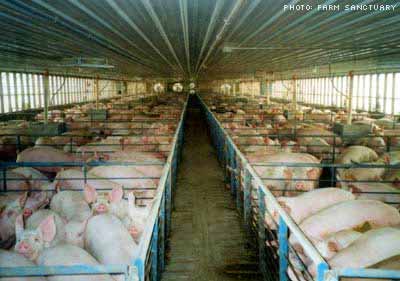
The environmental impact of the lifecycle and supply chain of animals raised for food has been vastly underestimated, and in fact accounts for at least half of all human-caused greenhouse gases (GHGs), according to Robert Goodland and Jeff Anhang, co-authors of "Livestock and Climate Change."
A widely cited 2006 report by the United Nations Food and Agriculture Organization, Livestock's Long Shadow, estimates that 18 percent of annual worldwide GHG emissions are attributable to cattle, buffalo, sheep, goats, camels, pigs, and poultry.
But recent analysis by Goodland and Anhang finds that livestock and their byproducts actually account for at least 32.6 billion tons of carbon dioxide per year, or 51 percent of annual worldwide GHG emissions.
ALL ANIMALS ARE EQUAL, BUT . . .
SOME ANIMALS ARE MORE EQUAL THAN OTHERS
By MARK BITTMAN (New York Times, 3/15/2011)
It’s time to take a look at the line between “pet” and “animal.” When the ASPCA sends an agent to the home of a Brooklyn family to arrest one of its members for allegedly killing a hamster, something is wrong.
That “something” is this: we protect “companion animals” like hamsters while largely ignoring what amounts to the torture of chickens and cows and pigs. In short, if I keep a pig as a pet, I can’t kick it. If I keep a pig I intend to sell for food, I can pretty much torture it. State laws known as “Common Farming Exemptions” allow industry — rather than lawmakers — to make any practice legal as long as it’s common. “In other words,” as Jonathan Safran Foer, the author of “Eating Animals,” wrote me via e-mail, “the industry has the power to define cruelty. It’s every bit as crazy as giving burglars the power to define trespassing.”
Meanwhile, there are pet police. So when 19-year-old Monique Smith slammed her sibling’s hamster on the floor and killed it, as she may have done in a fit of rage last week, an ASPCA agent — there are 18 of them, busily responding to animal cruelty calls in the five boroughs and occasionally beyond — arrested her. (The charges were later dropped, though Ms. Smith spent a night in jail at Rikers Island.)
In light of the way most animals are treated in this country, I’m pretty sure that ASPCA agents don’t need to spend their time in Brooklyn defending rodents.
In fact, there’s no rationality to be found here. Just a few blocks from Ms. Smith’s home, along the M subway line, the city routinely is poisoning rodents as quickly and futilely as it possibly can, though rats can be pets also. But that’s hardly the point. This is: we “process” (that means kill) nearly 10 billion animals annually in this country, approximately one-sixth of the world’s total.
Many if not most of these animals are raised (or not, since probably a couple of hundred million are killed at birth) industrially, in conditions that the philosopher Peter Singer and others have compared to concentration camps. Might we more usefully police those who keep egg-laying hens in cages so small the birds can’t open their wings, for example, than anger-management-challenged young people accused of hamstercide?
Yet Ms. Smith was charged as a felon, because in New York (and there are similar laws in other states) if you kick a dog or cat or hamster or, I suppose, a guppy, enough to “cause extreme physical pain” or do so “in an especially depraved or sadistic manner” you may be guilty of aggravated cruelty to animals, as long as you do this “with no justifiable purpose.”
But thanks to Common Farming Exemptions, as long as I “raise” animals for food and it’s done by my fellow “farmers” (in this case, manufacturers might be a better word), I can put around 200 million male chicks a year through grinders (graphic video here), castrate — mostly without anesthetic — 65 million calves and piglets a year, breed sick animals (don’t forget: more than half a billion eggs were recalled last summer, from just two Iowa farms) who in turn breed antibiotic-resistant bacteria, allow those sick animals to die without individual veterinary care, imprison animals in cages so small they cannot turn around, skin live animals, or kill animals en masse to stem disease outbreaks.
All of this is legal, because we will eat them.
We have “justifiable purposes”: pleasure (or, at this point, habit, because eating is hardly a pleasure if you do it in your car, or in 10 minutes), convenience — there are few things more filling per dollar than a cheeseburger — and of course corporate profits. We should be treating animals better and raising fewer of them; this would naturally reduce our consumption. All in all, a better situation for us, the animals, the world.
Arguing for the freedom to eat as much meat as you want is equivalent to arguing for treating farm animals as if they could not feel pain. Yet no one would defend Ms. Smith’s cruel action because it was a pet and therefore not born to be put through living hell.
Is it really that bad? After all, a new video from Smithfield, the world’s largest pork producer, makes industrial pig-raising seem like a little bit of heaven. But undercover videos from the Humane Society of the United States tell quite a different story, and a repulsive one. It also explains why we saw laws proposed by friends of agribusiness in both Iowa and Florida in recent weeks that would ban making such videos: the truth hurts, especially if you support the status quo.
Our fantasy is that until the industrial era domesticated animals were treated decently. Maybe that’s true, and maybe it isn’t; but certainly they weren’t turned out by the tens of thousands as if they were widgets.
We’re finally seeing some laws that take the first steps toward generally ameliorating cruelty to farm animals, and it’s safe to say that most of today’s small farmers and even some larger ones raise animals humanely. These few, at least, are treated with as much respect as the law believes we should treat a hamster.
For the majority of non-pets, though, it’s tough luck.
***
Thanks to Audrey for pointing out this piece in class.
Friday, March 25, 2011
Incremental Approach to Ending Animal Exploitation
Dara Lovitz’s talk confirmed for me that movement towards humane treatment of animals will only come in small increments. Our country is very entrenched in its current ideology that animals, especially farm animals, are meant for human use. The majority of Americans have ingrained views and customs concerning the consumption of meat. I do as well, although this class has led me to reconsider my actions and beliefs. Given the majority opinion radical change will not likely take place. Small changes which are more humane, but not completely humane and far from ideal, must take place first before humane treatment is reached for all animals. Dara’s discussion of Prop 2 which removed some inhumane conditions for calves and hens still left these animals in only minimally more humane conditions. Still, this is a small victory for advocates of animal rights law. However, it is a small increment in the right direction and next hopefully another small increment of success will build off of it. Eventually, I think these increments will build up until all animals are treated humanely in the United States.
The idea of incremental success reminded me of our readings on animal law. Tom Regan points out the difference between immediatists and gradualists. Gradualists believe in, “making the lives of some animals better today and in ending all animal exploitation in the future” (617). I agree with this stance. While it would be better to erase animal exploitation, it does not seem like a realistic goal in the short term. However, over the long term with small victories it does seem possible. Also, Peter Singer’s approach based off of Henry Spira’s ideas towards creating change in the treatment of animals makes sense to me as well. He advocates making changes that the public is ready for, which means choosing the goals which are the most likely to be met. By picking goals which few people would agree with are going to hit a brick wall. Goals which people outside the animal rights community could be persuaded to support will be met faster and gain momentum for the movement. For instance, I think persuading people to support changes in animal welfare laws to include pet stores may be a reasonable short term goal, however it does not solve the problem of persuading people to adopt shelter animals rather than buying an animal at pet store. Inhumane activities would continue, but the lives of some animals would be made better. This makes me think that small increments are worth fighting for.
Animal law's contradictions
Dara Lovitz raised some really important issues in her presentation on animal law on Wednesday. I have always been frustrated by the loopholes in animal law. It's great that some legislators have good intentions toward animals, but good intention is not enough. What animals need is action. Because it is so difficult for any type of wide-scale change to happen in today's society, governments figure they will make small changes bit by bit in order to accustom industries to new rules and regulations (not to mention the fact that these industries are trying to fight changes in regulations and such). And although there is no easy way to create a sudden and seamless rule change, politicians aren't acting quickly enough to end the mistreatment of animals that happens every day. Unfortunately, there isn't much of a solution to this problem. The most important thing to do is raise awareness of the problem. I would like to focus for a moment on the factory farming industry.
Factory farming, as one of the biggest polluters in the US and biggest industry/trade that employs animals, is a huge deal. And yet, the industry lobbies so hard in Congress that the issue has really only 'leaked' to the public through animal rescue organizations. I am a firm believer in the idea that the government doesn't always tell us what's up, and this is a great example of that issue. What the American public needs is education. If the US could be educated on a large scale about where exactly their food comes from, we'd be set--so many people would be outraged and the industry would fall into a deep slump, and, hopefully, completely fail. Of course, it's not as easy as that, but that is the general idea. The same goes for pet abuse and adoption: so many people choose not to adopt because they don't "trust" shelter pets. But people who say this are really being ignorant.
So the main idea I'm trying to get out is just one word: educate. It starts on an individual scale, so we should take advantage of every opportunity we have to educate, inform, and hopefully succeed.
Dara Lovitz Presentation - Mary Penxa
I found Dara's presentation moving on several accounts. First and foremost I felt the way she set up her powerpoint was highly successful in getting across the message. Since I am studying to be in the education field, I always like to see how other people structure their presentations. I felt her positive vs negative approach to the same issues really helped to show how even though strides are being made in a positive direction, there is certainly a long long way to go.
Some of the pictures were hard to look at, but I feel that ignorance is what a lot of people try to hide behind when it comes to the "it's not my animal - it's not my problem" type of view. I believe if more people saw some of the horrible things that animals actually go through in these cruel situations, they would be far less likely to just pass off the issues as "no big deal".
Her presentation really made me think about how working for animal justice is such a hard thing to do. While you are working for such a wonderful thing, it sometimes always feels like no matter what you do, there are still obstacles. I can really relate to that in my experience in volunteering at the SPCA. I love volunteering there and it really gives me so much joy helping these dogs out. But I can't lie a lot of times it makes me feel extremely sad to. Like no matter how many dogs I walk, there are still some who haven't been able to get outside all day. And no matter how hard I try wonderful dogs are still being put down.
Her presentation really reiterated the fact that we sometimes can feel helpless in these matters. But it also showed that when people ban together that changes can be made. That's what keeps me coming back to the shelter every time. Knowing there is a dog who maybe had just a little better of a day because of me.
While it's easy to feel helpless and like the problem is outside of us, Dara's presentation really hit home that the only way it even begins to get better, is if we keep trying despite this.
-Mary Penxa
Animal law's ups and mostly downs
Having seen Dara Lovitz speak earlier this year at Grindcore House, and having read some of Muzzling a Movement, it was really special to have her come to our very own intimate classroom setting and speak directly to us about her opinions regarding animal law. When I saw her at Grindcore, I came a bit late and it was sort of hard to put where the discussion was in context or emerge myself into the conversation. I wish our class had more time at the end of her presentation to discuss what the food and pet industries do to animals and how animal activists are restricted and oppressed by the government. BUT, within our limited class time, I still felt she covered a lot of good bases.
For example, I was happy she mentioned "Prop 2" as it is quite an advancement for animal rights, yet very contradictory because despite how much "more humane" the slaughter system is made- until animals are no longer produced in factories for human purposes. Furthermore, "Prop 2" still denies animals the right to socialize or live out their lives naturally. Violence and suffering surrounds most domesticated animals at at least one point during their often short lives. So therefore, Animal Law is not successful in "protecting animals" which is it's inherent purpose.
I am also glad that Dara discussed how guardianship and vetrinary malpractice is different because animals are still considered objects, not individuals nor family members. I feel like issues in which monetary value is relayed to the owners of pets, (such as in cases of tainted pet food recalls, malpractice, etc), animals are only further objectivied, which sends me into a nihilistic bad mood- similar to how "GOOD" organizations such as the SPCA makes me feel.
For now, we will have to be patient as Animal law slowly advances and we hopefully head towards a less violent and more open-minded society.
The inevitability of utilitarianism
I was really interested in Dara Lovitz's discussion with us on Animal Law. I've always had an interest in politics and government, and I enjoyed hearing about animal issues from a legal point of view.
Wednesday's talk reminded me of the insanely slow and difficult process of government. It is always a uphill battle to voice your opinion and a struggle to make any kinds of serious reform. The fact that Prop 2 had finally passed is a great achievement in and of itself, though of course, the terms were not as stringent as most activists would have liked.
Reflecting on these issues of concern reminded me of the conflict between rights activists and utilitarian activists.
When I read the articles out of our Animal Ethics book, there are many times when it's easy for me to say, "we have to focus on the individual animals and not group them all together and assume the same details for each and every one." In an idealistic way, I completely understand rights activists and support them. But listening to Dara speak reminded me of how inevitable utilitarianism is. In government, there are rarely individuals. Each member of congress, every judge, every mayor... they all speak for more than themselves. They represent our country, and make our decisions for us. While we know our president by name, his actions do more than represent himself, they represent our country.
So it stands to reason that since it is impossible to have individual human animals represented in government, that is it impossible to have individual nonhuman animals represented in government as well. While this makes it harder for rights activists to get their points across, it is the only way our country can function without becoming a collective anarchy.
I am not saying this to dishearten or look down on rights activists. They believe strongly in what they do and hold to their values, which is highly commendable. But I do think that understanding the intricacies and inevitabilities our of government could strongly help them in finding a louder voice.
Subscribe to:
Posts (Atom)